Powder Metal Components
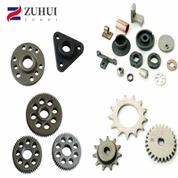
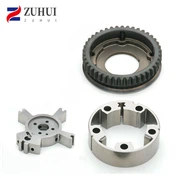
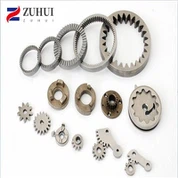
Powder metal components refer to metal parts manufactured through powder metallurgy processes. Powder metallurgy process is a method of using metal powder as raw material to manufacture components with the desired shape and properties through processes such as molding and sintering. This method can produce complex shapes and high-quality components that are difficult to achieve through traditional casting and forging

- Product Introduction
Product Introduction
Basic steps of powder metallurgy process
1. Raw material preparation: Use metal powders as raw materials, which can be single metals or alloys.
2. Molding: Metal powder is molded into the desired shape through methods such as compression or injection molding.
3. Sintering: Sintering the green body at high temperature to bond the powder particles into a solid whole.
4. Follow up processing: Depending on the needs, heat treatment, surface treatment and other processes may be carried out to improve the performance of the components
Advantages and disadvantages of powder metallurgy process
advantages:
1.High precision: It can manufacture components with complex shapes and high precision.
2.High material utilization rate: Powder metallurgy can reduce material waste and improve material utilization rate.
3.Excellent performance: By controlling the composition and process, high-performance materials and components can be obtained.
4.Cost effectiveness: Suitable for small batch production, with relatively low costs.
Disadvantages:
1.Poor ductility and impact performance: Due to the presence of pores inside, the ductility and impact performance are not as good as traditional casting and forging materials.
2. Large equipment investment: requires specialized equipment and molds, with a relatively high initial investment
product Parameter (specification)
|
Commodity |
Factory customize high precision powder metal components |
|
General Material |
Aluminum: 5000series(5052...)/6000series(6061…)/7000series(7075…) Steel: Carbon Steel, Middle Steel, Steel Alloy, etc. Stainless Steel: 303/304/316,etc. |
|
Processing |
CNC machining, Turning, Milling, Stamping, Grinding, Welding, Lathing, Cutting, Die casting, forging, cnc turning ,casting ,sintering ,bending , Painting |
|
Size |
Customized Sizes /According to Customer's drawing or samples |
| Tolerance | PM: 0.01mm; CNC : 0.001mm-0.006mm |
| Application | Automobile, motorcycle, textile machinery, industrial sewing machine, power tools, hardware tools, electrical appliances, engineering machinery |
High Precision Powder Metal Components


Company Profile


FAQ
How to improve the strength of powder metal components through raw material selection?
| Method category | Specific approach | Advantages explanation |
| Select high-purity powder | Choose metal powders with low impurities and high purity (such as alloy steel, stainless steel, etc.) | Reduce internal defects, improve density and strength |
| Control powder particle size | Use powders with uniform particle size distribution to avoid particles that are too large or too small | Uniform filling, improving compaction density and sintering effect |
| Adding alloy elements | Adding alloying elements such as chromium, molybdenum, and copper to enhance material properties | Improve tensile strength, wear resistance, and toughness |
| Add hard particles | Adding hard particles or reinforcing fibers to the powder | Improve surface hardness and wear resistance |
| Powder mixing optimization | Ensure even mixing of powders and maintain consistent proportions of ingredients | Ensure stable material performance and avoid local weaknesses |
Hot Tags: powder metal components, China powder metal components manufacturers, suppliers, factory