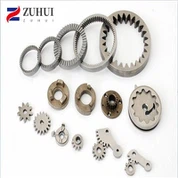
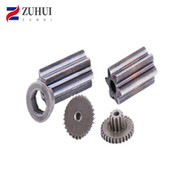
Powder Metallurgy Components
Powder metallurgy components refer to products manufactured through powder metallurgy processes, including porous, semi dense, or fully dense materials and products.

- Product Introduction
Classification of powder metallurgy components
Powder metallurgy components can be classified into the following types according to their usage:
(1) Powder metallurgy high-temperature materials. Including powder metallurgy high-temperature alloys, refractory metals and alloys, metal ceramics, dispersion strengthening and fiber strengthening materials, etc. Used for manufacturing turbine discs, nozzles, blades, and other high-temperature resistant components for use at high temperatures.
(2) Powder metallurgy tooling materials. Including hard alloys, powder metallurgy high-speed steel, etc. The latter has uniform organization, small grains, no segregation, better toughness and wear resistance than cast high-speed steel, less heat treatment deformation, and longer service life. Billets that can be used to manufacture cutting tools, molds, and parts
(3) Powder metallurgy anti friction materials. Also known as sintered anti friction materials. Made by immersing lubricating oil in the pores of the material or adding friction reducing agents or solid lubricants to the material composition. The friction coefficient between material surfaces is small, and under the condition of limited lubricating oil, the service life is long and the reliability is high; Under dry friction conditions, relying on the lubricant contained on itself or on the surface layer, it has a self-lubricating effect. Widely used in the manufacturing of bearings, support bushings, or as end face seals.
(4) Powder metallurgy porous materials. Also known as porous sintered materials. Formed and sintered from spherical or irregularly shaped metal or alloy powders. The internal pores of the material are crisscrossed and interconnected, with a volume porosity of 30% to 60% and a pore size of 1-100 microns. Good permeability, thermal conductivity, and electrical conductivity, resistant to high and low temperatures, thermal shock, and medium corrosion. Used for manufacturing filters, porous electrodes, fire extinguishing devices, antifreeze devices, etc.
(5) Powder metallurgy friction materials. Also known as sintered friction materials. Composed of three parts: base metal (copper, iron or other alloys), lubricating components (lead, graphite, molybdenum disulfide, etc.), and friction components (silicon dioxide, asbestos, etc.). It has a high friction coefficient, can quickly absorb kinetic energy, fast braking and transmission speed, and low wear; High strength, high temperature resistance, and good thermal conductivity; Good bite resistance, corrosion resistance, and less affected by grease and moisture. Mainly used for manufacturing clutches and brakes.
product Parameter (specification)
|
Commodity |
Factory custom high precision powder metallurgy powder metallurgy components |
|
General Material |
Iron , Stainless Steel Powder |
|
Material Standard |
MPIF 35,DIN 30910,JIS Z 2550 |
|
Application |
small home appliances, Lockset, Electric tool automobile |
|
Process |
Powder Metallurgr,CNC Machining |
|
Density Range |
5.8-7.8g/cm3(Fe) |
|
Finish |
Grinding, Machining, Oil Immersion, Steam Oxidation, Electroplate |
Related Products

Advantages of Powder Metallurgy components
1. High precision
Powder metallurgy is a technology that can manufacture complex shaped parts with high forming accuracy and surface quality, which cannot be compared to other processes. The manufactured parts can reach a level where there is almost no need for subsequent processing, providing strong support for industrial automation and improving production efficiency.
2. The data is relatively stable
Due to being manufactured at specific temperatures and pressures, the data is relatively stable and has repeatability, resulting in a relatively stable production process. Large scale production can be carried out with qualified product quality, which greatly improves the production efficiency of some automated assembly lines.
3. High material utilization rate
The waste generated in manufacturing can be recycled and reused through certain methods, avoiding the problem of resource waste. In addition, powder metallurgy can manufacture various complex shaped parts without causing material waste like other processes.
FAQ
Common process defects and avoidance methods in the manufacturing process of powder metallurgy components
Powder metallurgy is a widely used material forming technology, especially in industries such as automotive, machinery, and electronics. However, during the manufacturing process, some process defects may occur due to various reasons. These defects not only affect the performance and quality of the parts, but may even lead to product scrapping and safety accidents. Therefore, understanding these common defects and their avoidance methods is crucial for improving product quality.
1, Common process defects
• Uneven density
Reason: It may be due to uneven powder mixing and uneven distribution of pressing pressure.
Performance: Causing inconsistency in the internal structure of the parts, affecting their physical and mechanical properties.
• Dimensional deviation
Reasons: mold accuracy issues, improper control of the pressing process, etc.
Performance: The actual dimensions of the parts do not match the design requirements, which may affect assembly accuracy.
• Crackle
Reason: Problems with the material itself, excessive pressing pressure, or improper demolding.
Performance: Cracks can reduce the strength and durability of parts, and in severe cases may lead to part fracture.
• Roughness
Reason: Large powder particles, improper molding process, etc.
Performance: Poor surface quality, affecting both aesthetics and functionality.
• Pore
Reason: The powder contains gas, insufficient compression pressure, etc.
Performance: Pores can reduce the density and strength of parts.
• Geometric tolerance exceeds the tolerance limit
Reason: Issues related to straightness, parallelism, coaxiality, etc. are usually related to mold accuracy, pressing fixtures, and equipment precision.
• Unqualified appearance
Reasons: high roughness, excessive burrs, missing edges and corners, pulling and cracking, etc.
Performance: Affects the appearance quality and usability of the parts.
• Machining defects
Types: Dimensional deviation, surface roughness, microstructural damage, cracks and fractures, burrs and unevenness, etc.
Reason: Material characteristics, improper tool selection, improper operation, etc.
2, Avoiding methods
• Optimize powder mixing process
Ensure that the powder is mixed evenly to reduce the problem of uneven density.
• Improve mold accuracy
Strictly control the design and manufacturing accuracy of the mold to ensure dimensional stability during the pressing process.
• Adjust the suppression parameters
According to specific material and part requirements, adjust the pressing pressure, speed and other parameters reasonably to avoid cracks and form and position tolerances exceeding the tolerance limit.
• Select appropriate powder particles
The use of finer powder particles can effectively improve surface roughness.
• Pre treated powder
Pre treat the powder to remove gas, increase compression pressure, and reduce the formation of pores.
• Optimize machining process
Accurately control machining parameters such as cutting speed and feed rate, select cutting tools suitable for powder metallurgy materials, and regularly inspect and replace worn tools.
• Strengthen quality control
Including raw material inspection, process parameter control, and product testing, to reduce the occurrence of defects from the source.
• SUPPLIER MANAGEMENT
Strengthen the management and audit of suppliers to ensure that the materials and parts provided meet quality requirements.
• Design optimization
Fully consider the characteristics and limitations of powder metallurgy parts during the design phase, and carry out reasonable design optimization to reduce potential defect risks.
Hot Tags: powder metallurgy components, China powder metallurgy components manufacturers, suppliers, factory