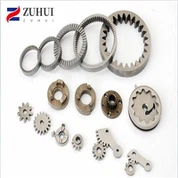
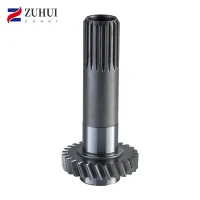
Sintered Metal Components
Sintered metal components refer to sintered products formed from powder and strengthened by sintering. Sintered metal components usually have precise tolerances and are easy to install. The material powder mixture also contains lubricants to reduce the frictional force generated during pressing. Powder mixture is the initial material for manufacturing sintered parts. The basic powder can be pure iron, low alloy steel, stainless steel, or high-speed steel. The performance of the final part can be adjusted by using additives such as carbon, alloying elements, and cutting enhancing agents. The powder mixture also contains lubricants to reduce the frictional force generated during pressing.

- Product Introduction
Product Introduction
Application of sintered metal components
By using iron powder as the main raw material, adding different alloying elements, and utilizing different preparation processes, different types of sintered metal components with different mechanical properties, meeting user needs, and having wide market applications can be obtained. There are 11 representative parts as follows:
(1) EA888 sprocket set
(2) T5D transmission synchronizer hub
(3) camshaft timing sprocket
(4) VVT stator
(5) transmission oil pump rotor
(6) manual transmission interlock block
(7) timing exhaust camshaft pulley
(8) VVT high-precision rotor
(9) engine VVT stator
(10) crankshaft double row sprocket
(11) balance shaft driven gear assembly
product Parameter (specification)
|
Commodity |
Factory custom high precision powder metallurgy PM sintered metal components |
|
General Material |
Stainless steel, Iron, Brass, Copper |
|
Application |
small home appliances, Lockset, Electric tool automobile |
|
Process |
Powder Metallurgy (PM), CNC Machining |
|
Density Range |
5.8-7.8g/cm3(Fe) |
|
Finish |
Grinding, Machining, Oil Immersion, Steam Oxidation, Electroplate |
|
MOQ |
5000 PCS |
Related Products

Contrast for PM and Traditional Process
| Item | PM | Precision Casting | Machining Operation | Stamping |
| Range of Applying Material | High | Medium-High | Medium | Medium |
| Design Tolerance | High | High | High | Low |
| Small size | High | Low | High | High |
| Thickness | High | High | Low | High |
| Supply Ability | High | Medium | Low | High |
| Raw material | High | Low | Low | Low |
Contrast for PM and Precision Casting Molding
| Property | PM | Precision Casting Molding |
| Surface Roughness | Ra1.6 | Ra1.6 |
| Minimum Thickness | 0.8mm | 2mm |
| Maximum Thickness | 60mm | Unlimited |
| Minimum Diameter | 0.5mm | 2mm |
| Tolerance of Diameter | +/-0.01mm | +/-0 2mm |
FAQ
Performance characteristics of sintered metal components
1.Mechanical properties
• Good shape retention: Components with good shape retention can be manufactured through injection molding, which can accurately achieve complex shape design, ensure that the components are not easily deformed during the molding process, and guarantee the accuracy and consistency of the product.
• High strength and density: Research has been devoted to manufacturing sintered metal components with high density and no defects, indicating that sintered metal components can have high strength and density, making them more robust and durable when subjected to external forces.
• Good fatigue resistance: 80% of the damage to equipment components and metal parts is due to fatigue failure caused by various micro and macro mechanical stress concentrations. Sintered metal parts, after special manufacturing processes, have a more uniform and dense microstructure, which can better disperse stress and thus have good fatigue resistance, extending their service life.
2. Physical property
Controllable composition: The proportion of various metal components in sintered metal parts can be precisely controlled according to different usage needs. For example, the copper content in sintered metal plates can be controlled to exceed 50% -60%, and other components such as carbon and tin can also be included to meet different physical performance requirements.
• Non radiative components: Some sintered metal parts can undergo complex purification processes during the manufacturing process, without any heavy metal components that can cause radiation. They are suitable for applications with strict radiation requirements, such as precision electronic devices or medical equipment.
• Wear resistance
It has good wear resistance, thanks to its special manufacturing process that forms a uniform and dense structure on the surface of the components, which can effectively resist wear and perform well in applications that require frequent friction or contact, such as metal components in metal based diamond tools, which can maintain good performance over long periods of use.
3.Filterability
• Stable airflow: Taking sintered metal cylinder as an example, the actual measurement results show that the radial unevenness of the blowing is less than 10%, and the airflow is stable. This makes sintered metal components have important application value in the field of filtration, which can provide stable filtration effect and ensure the efficiency and reliability of the filtration process.
• Can be used as a filtering medium: It can be used as a filtering medium and plays an important role in filtration technology. With the development of filtration technology, the application of sintered metal media is becoming increasingly widespread, which can effectively filter particles of different sizes and meet different filtration needs.
Hot Tags: sintered metal components, China sintered metal components manufacturers, suppliers, factory, sintered door parts, sintered window parts