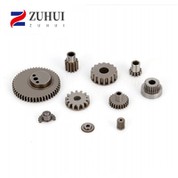
Powder Sintering Planetary Gear
Powder sintering planetary gears are gears manufactured using powder metallurgy technology, which form specific gear shapes through a series of processes such as sintering in a powder state. Common powder sintered planetary gears include small modulus gears and other types, and the material is generally powder metallurgy.

- Product Introduction
Product Features
1.High-precision
Powder metallurgy technology can achieve extremely high dimensional accuracy and positional tolerance control in the manufacturing of planetary gears. Compared with traditional processing methods, mold forming and precision sintering can better ensure the dimensional consistency and surface quality of key parts of gears. High precision meshing can reduce friction loss between gears, lower transmission noise, improve power transmission efficiency, make car travel smoother and more stable, and also help improve fuel economy.
2.Excellent mechanical performance
• High strength and toughness: Through reasonable powder formula design and optimized sintering process, powder metallurgy planetary gears have good comprehensive mechanical properties, can withstand high torque, are not easily deformed or damaged under complex working conditions, and can maintain stable structural strength and toughness even after long-term use, effectively avoiding failures caused by fatigue failure, improving the reliability and durability of the transmission system, reducing maintenance costs and downtime.
• Good wear resistance: Powder metallurgy materials can increase surface hardness and enhance wear resistance by adding wear-resistant alloy elements or using surface treatment techniques at positions where there is relative motion and friction in gear contact. This can enable gears to better resist wear throughout their entire service life, maintain good fit accuracy, ensure stable transmission system performance, extend component replacement cycles, and reduce usage costs.
3.Lightweight design
When manufacturing planetary gears using powder metallurgy technology, lightweight goals can be achieved by optimizing structural design and controlling material density without compromising component performance. Compared to traditional casting or forging gears, it can reduce its own weight while ensuring sufficient strength and stiffness, which helps to lower the overall weight of the car, reduce inertia resistance, make the car travel more flexible and lightweight, indirectly reduce fuel consumption and exhaust emissions, and comply with environmental protection and energy-saving concepts.
4.Integrated molding of complex shapes
Powder metallurgy technology can use molds to shape various complex shapes required for gears in one go, avoiding the tedious process of multi process processing and assembly in traditional machining methods. This integrated molding method improves production efficiency, reduces production costs, minimizes stress concentration and sealing issues caused by splicing, and enhances the overall quality and reliability of the components.
5.High material utilization rate and significant cost-effectiveness
In the production process of powder metallurgy, raw materials exist in powder form. Through precise mold filling and forming, materials can be maximally utilized and waste can be reduced. Compared to traditional cutting processes, the material utilization rate is usually higher, making powder metallurgy planetary gears cost-effective while ensuring high performance
product Parameter (specification)
|
Commodity |
Factory customized high precision strong wear resistance powder sintering planetary gear |
| Process Flow |
Powder Mixing-Forming-Sintering-oil Impregnation |
|
Material |
Fc0208/Fn0208 |
| Specification | Customized |
| Surface Treatment | High Frequency Quenching Oil Impregnation CNC |
|
MOQ |
5000 PCS |
| Application | Motor, Electric Cars, Motorcycle, Machinery, Marine, Toy, Agricultural Machinery, Car |
FAQ
Powder sintering planetary gears are the core components of precision transmission systems such as automotive transmissions, and their performance indicators directly affect system reliability. Based on industry applications and testing standards, the core performance indicators and evaluation methods are as follows:
1, Key performance indicators
① strength
Bending strength: determines the ability of gears to withstand loads and avoid root fracture. Powder metallurgy improves strength by optimizing the iron powder composition ratio (such as carbon/copper content).
Compressive strength: The planetary support needs to withstand the high torque transmitted by the planetary gears and ensure that it does not deform under high-pressure conditions.
② resilience
Prevent brittle fracture of gears under impact loads. This is achieved by adjusting the sintering process (such as temperature control) and adding tough metal powders (such as copper based alloys).
③ wear resistance
Reduce tooth surface wear and extend lifespan. Mainly relying on two aspects:
Material optimization: adding wear-resistant alloy elements (such as Mo, Cr);
Surface treatment: Shot peening hardening, solid lubricating coating (such as PTFE) to reduce friction coefficient.
④ fatigue resistance
Ensure that the gear does not experience fatigue fracture under alternating loads (such as frequent start stop). Shot peening can form a compressive stress layer on the surface, delaying crack initiation.
⑤ Geometric accuracy and surface performance
Dimensional accuracy: Mold forming control planetary gear installation tolerance (± 0.02mm level), ensuring smooth meshing;
Surface roughness: affects transmission efficiency and needs to be reduced to Ra ≤ 0.8 μ m through grinding/polishing
2, Testing and Evaluation Methods
① Material mechanical performance testing
| Index | Test method | Standard reference |
| Bending strength | Three point bending test (ISO 3325) | Determination of tooth root bearing limit |
| Hardness | Rockwell hardness tester (HRC scale) | Evaluate the surface hardening effect |
| Resilience | Charpy impact test (ISO 5754) | Analyze the energy absorbed by fracture |
② Wear resistance and fatigue testing
Wear resistance test: firstly, through bench testing, simulate actual working conditions, and measure the mass loss after 10000 cycles; The second is to use a pin disc wear tester to test the friction coefficient and quantify the lubrication effect of the coating.
Fatigue resistance test: using rotational bending fatigue test (such as ISO 1143) to determine the fatigue limit; Through transmission bench testing, load alternating torque until the gear fails, and record the number of cycles.
③ Geometry and Surface Inspection
Roughness detection: Use a laser interferometer or white light interferometer with an accuracy of ± 0.01 μ m to detect the surface roughness of gears.
Tooth profile accuracy detection: Use gear measurement centers, such as Klingelnberg P series, to analyze tooth profile deviation.
Microstructure detection: Observe the pore distribution and sintering density through a metallographic microscope, and the target density is generally required to be ≥ 7.2g/cm ³.
④ Dynamic performance verification
NVH testing: Monitor gear meshing noise in the anechoic chamber, with a target requirement of ≤ 75dB.
Transmission efficiency test: Comparing input and output power, the optimized transmission efficiency can reach over 98%
Hot Tags: powder sintering planetary gear, China powder sintering planetary gear manufacturers, suppliers, factory, powder metallurgy tempering, powder metallurgy quality, powder metallurgy astm standards, powder metallurgy optimization, powder metallurgy toughness, powder metallurgy email marketing