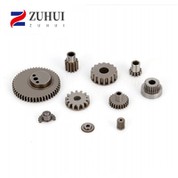
Sinter Planetary Gear
Sinter planetary gears are planetary gears manufactured using powder metallurgy technology, often using solid-phase sintering method, under specific sintering atmosphere (such as ammonia decomposition) and sintering temperature of 1050-2000 ℃. It has the characteristics of small volume, light weight, high speed ratio, high efficiency, and power splitting of planetary gears. When transmitting power, the input shaft and output shaft are on the same horizontal line. It is widely used in mechanical transmission systems such as reducers and transmission devices, especially in aircraft and vehicles (especially heavy vehicles), and plays an important role in engine torque transmission.

- Product Introduction
The influence of sintering process on internal stress of planetary gears and control methods
• The reason for the generation of internal stress during sintering: During high-temperature sintering, there is mutual attraction between molecules (or atoms) in the solid state. By heating, the particles obtain sufficient energy to migrate, causing particle bonding in the powder, resulting in strength and densification and recrystallization. This process generates corresponding internal stress.
• The influence of multi-layer stacking on the bottom gear: In the sintering process of general planetary gears, due to the stacking of each planetary gear, the bottom planetary gear is subjected to the gravity stacking of the upper planetary gear during the sintering process, which will generate corresponding internal stress and reduce the product quality.
• The role of fixture design in controlling internal stress: By designing the dimensions related to the height of the sintering fixture's sleeve rod and the thickness of the planetary gear, such as the height of the sleeve rod being less than six times the thickness of the planetary gear, and the number of planetary gears stacked on the sleeve rod not exceeding five, it ensures that the internal stress generated by the stacking of planetary gears during the sintering process is within an adjustable range, and improves the qualification rate of planetary gears after sintering
product Parameter (specification)
|
Commodity |
Factory customized high precision strong wear resistance powder metallurgy sinter planetary gear |
| Process Flow |
Powder Mixing-Forming-Sintering-oil Impregnation |
|
Material |
Metal |
| Specification | Customized |
| Surface Treatment | High Frequency Quenching Oil Impregnation CNC |
| Tolerance | ±0.3% |
| Application | Motor, Electric Cars, Motorcycle, Machinery, Marine, Toy, Agricultural Machinery, Car |
FAQ
Problems of sintered planetary gears in practical applications
1. Internal stress issues
During the sintering process, planetary gears may generate internal stresses. This is because during the sintering process, the planetary gears overlap with each other, causing the bottommost planetary gear to be subjected to the gravity of the upper planetary gear, resulting in corresponding internal stress. If the internal stress during product sintering is not controlled and eliminated, the service life of the product will be greatly reduced.
2. Noise issue
Planetary gears are prone to producing significant noise during operation, which seriously affects the efficiency of machine use. The main causes of noise problems include gear tooth profile errors, poor lubrication, and excessive gear clearance. When manufacturing planetary gears, tooth profile errors are prone to occur due to processing techniques and assembly accuracy, resulting in friction, vibration, and noise during operation. In addition, poor lubrication can also lead to increased friction and wear, resulting in noise. Excessive gear clearance can cause gear oscillation and vibration, further generating noise.
3. Temperature rise issue
Planetary gears generate friction and heat during operation, and due to their structural characteristics, they have poor heat dissipation conditions and are prone to high temperatures. The main causes of temperature rise issues include gear friction, poor lubrication, and structural problems. Excessive friction can lead to excessive heat generated by gears, while insufficient or improper use of lubricants can also result in increased friction and heat. In addition, there is a certain gap between the gear and the ring gear in the structure of planetary gears, which can form hot spots and cause temperature rise.
4. Tooth breakage issue
As the core component of mechanical transmission systems, the performance of powder metallurgy planetary gears directly affects the stability and safety of the entire system. However, tooth breakage has always been an important challenge in this field, as it not only affects the lifespan of gears but may also cause serious mechanical failures. The occurrence of tooth breakage may be related to multiple factors such as material selection, process control, structural design, and maintenance.
Solution measures
1. Optimize materials and processes: Select high-strength alloy powders, use warm pressing or re pressing processes to increase material density, add alloy elements to enhance material toughness, and optimize heat treatment processes.
2. Improve structural design: avoid stress concentration, optimize modulus and pressure angle design, and strengthen tooth roots.
3. Standardized use and maintenance: Avoid overload and frequent impact, ensure that the gears are fully lubricated, regularly clean and inspect the condition of the gears.
4. Control the internal stress during the sintering process: Design specialized sintering fixtures to control the number of planetary gears stacked during the sintering process, in order to effectively control the internal stress.
Hot Tags: sinter planetary gear, China sinter planetary gear manufacturers, suppliers, factory, powder metallurgy equipment, powder metallurgy regulations, powder metallurgy magnetic properties, powder metallurgy jis standards, powder metallurgy documentation, powder metallurgy inventory management