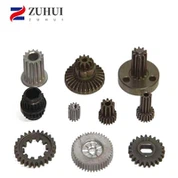
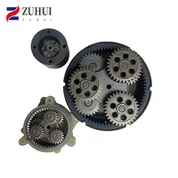
Powder Metallurgy Pinion
Powder metallurgy pinions are micro gear parts produced using powder metallurgy technology, using metal powders (commonly iron-based, copper based, stainless steel powders, etc.) as raw materials, through processes such as powder mixing, compression molding, sintering, and subsequent finishing/machining. The size is usually between a few millimeters and tens of millimeters, and is widely used in precision transmission scenarios.

- Product Introduction
product Details
|
Commodity |
Factory customized high precision strong wear resistance powder metallurgy pinion |
| Modular range | 0.1-2.0mm |
| Number of teeth range | 10-100 teeth |
| Outer diameter tolerance | ±0.01mm - ±0.03mm |
| Tooth surface roughness | Ra0.8-Ra3.2μm |
| Density | 6.0-7.2g/cm³ ( iron based ) |
| Tensile strength | 300-800MPa |
Core production process
• Powder mixing: Mix metal powder with lubricant and alloy element powder in proportion to ensure uniform composition and provide a foundation for subsequent molding .
• Compression molding: The mixed powder is compressed into gear blanks that are close to the final shape through high pressure in a dedicated mold, ensuring basic tooth profile and dimensional accuracy .
• Sintering: Heating in a protective atmosphere furnace to a temperature below the melting point of the metal, allowing the powder particles to form a dense metallurgical bond through atomic diffusion bonding, and obtaining stable mechanical properties .
• Post processing: Refine according to requirements (improve dimensional accuracy), machine (supplement complex structures), heat treatment (strengthen hardness), surface treatment (rust prevention, friction reduction) and other processes .
key advantage
• Controllable accuracy: The mold forming and finishing process can ensure that the tooth profile accuracy reaches levels 7-9 of GB/T 10095.1, meeting the requirements of precision transmission .
• High material utilization rate: Near net forming technology reduces material waste, with a material utilization rate of over 90%, far exceeding traditional cutting processing .
• Adjustable performance: By adjusting the powder composition and sintering process, gears with different strengths, hardness, and wear resistance can be customized to adapt to different working conditions .
• Low batch cost: suitable for large-scale automated production, the larger the batch, the more obvious the cost advantage of a single piece .
• Internal structure can be designed: It can produce self-lubricating gears containing oil, store lubricating oil in the pores, and achieve maintenance free or minimal maintenance .
Typical application scenarios
• Automotive field: engine valve timing system, seat adjustment motor, window lifting mechanism .
• Home appliance industry: washing machine clutch, air conditioning damper actuator, electric toothbrush transmission system .
• Office equipment: printer feed mechanism, copier developing component .
• Electric tools: handheld drill gearbox, garden tool transmission system .
Common Material Systems
| Material Type | Representative components | Hardness range | Applicable scenarios |
| Iron based powder metallurgy | Fe-Cu-C,Fe-Ni-C | HB120-300 | High load transmission, automotive components |
| Copper based powder metallurgy | Cu-Zn,Cu-Sn | HB60-150 | Low load, high wear resistance scenario |
| Stainless steel powder metallurgy | 304L,316L | HB150-250 | Corrosion resistance, food and medical fields |
Hot Tags: powder metallurgy pinion, China powder metallurgy pinion manufacturers, suppliers, factory, powder metallurgy metrology, powder metallurgy social media marketing, powder metallurgy online shopping, powder metallurgy reuse, powder metallurgy iron powder, powder metallurgy sustainability