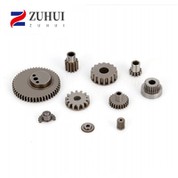
OEM Sintered Gear
Sintered gears belong to powder metallurgy products, and their manufacturing process involves mixing metal powders (such as iron-based and copper based powders) according to a formula, pressing them into the blank shape of the gear through a mold, and then high-temperature sintering (usually heated to a temperature below the melting point of the powder in a protective atmosphere) to combine the powder particles. Finally, they are made through processes such as finishing and heat treatment.

- Product Introduction
product Details
|
Commodity |
Factory customized high precision strong wear resistance sintered gear |
| Accuracy | ±0.02mm |
| Density | 6.7-7.4g/cm³ |
| Hardness | HRC30-40 (after heat treatment ) |
| Sintering Temperature | 1050-2000℃ |
| MOQ | 2000 PCS |
Core Features
• High material utilization rate: Powder metallurgy near net forming process reduces cutting processing and material waste (traditional cutting processing material utilization rate is about 40% -60%, sintering process can reach over 95%).
• Suitable for complex shapes: It can form gears with complex structures such as inserts, irregular holes, and splines in one go, reducing assembly difficulty.
• Controllable performance: By adjusting the powder composition and sintering process, different densities (6.0-7.2g/cm ³) and mechanical properties (hardness, strength) can be obtained to meet the requirements of different working conditions.
• Cost advantage: In mass production, after diluting the mold cost, the overall cost is lower than forging or cutting gears.
Application scenarios
• In the automotive field: transmission gears, differential gears, engine timing gears, etc. (such as some Toyota and Volkswagen models that use sintered gears for weight reduction and noise reduction).
• Household appliances and office equipment: low load scenarios such as washing machine transmission gears and printer paper feeding gears.
• Precision machinery: small reducers, robot joint gears (relying on high-precision sintered molds to ensure tooth profile accuracy).
Compared with traditional gears
| Comparison item | Sintered gear | Forging/cutting gears |
| Material Utilization Rate | 85% -95% (near net shape) | 40% -60% (requiring extensive cutting) |
| Production Cost | Lower during mass production | Low individual cost, high batch cost |
| Strength | Medium (can be improved through heat treatment) | Higher (forging can refine grain size) |
| Applicable scenarios | Transmission components with small to medium loads and large batches | High load, high-precision transmission system |
Hot Tags: oem sintered gear, China oem sintered gear manufacturers, suppliers, factory, powder metallurgy inventory management, powder metallurgy ductility, powder metallurgy development, powder metallurgy digital marketing, powder metallurgy products, powder metallurgy for oil and gas